
People have used natural stone for many purposes since antiquity. Expressions such as “solid as a rock” reflect its established association with strength and permanence.
Natural stone is becoming increasingly popular in building finishes as clients seek comfortable, lasting homes and properties that can be passed to future generations. Ideas such as the family estate are returning in a contemporary form.
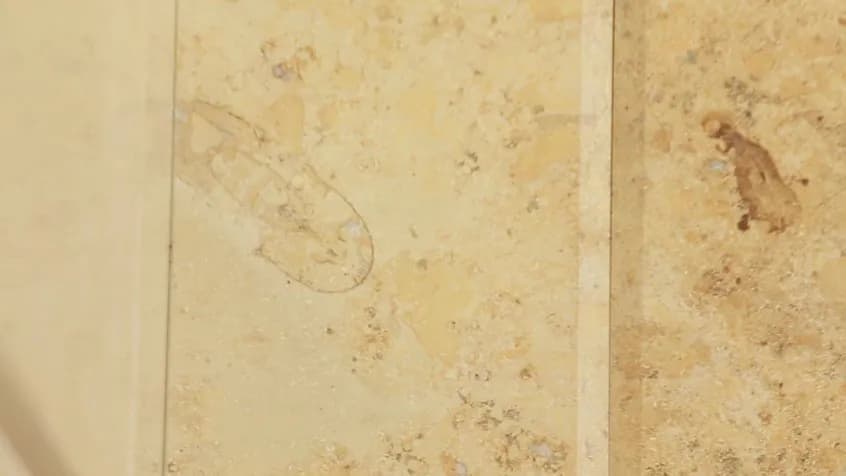 🔍
🔍Detail of the second-level balustrade in the atrium of Moscow's Central Children's Store
Natural stone occurs in many mineral compositions and colours, yet beige carbonate rocks have become especially popular. Beige covers light-brown, cream and greyed tones reminiscent of skin or undyed wool. Jura Limestone offers this range in different quarry layers and locations.
Brown is a non-spectral colour associated with bark. On the NCS scale, relevant tones include S 5020–5040-Y20–30R; visually they arise from combinations of black or grey, yellow and red pigments.
Brown is widespread in nature: tree bark, soil, fallen leaves, animal fur, tea, chocolate and clay all occupy this familiar family of colours.
Modern life is fast and saturated with information, advertising and visual stimulation. People often seek calm, familiar surroundings in response. Beige, brown and golden tones recall timber, rural houses and fields of wheat, which helps explain their popularity in architecture. Jura Limestone provides a broad beige palette enriched by darker fossils from Jurassic marine life.
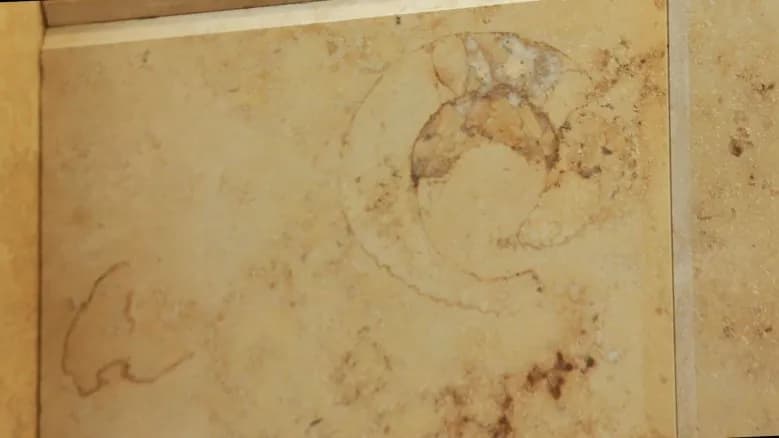 🔍
🔍Detail of the atrium interior at Moscow's Central Children's Store
Within this palette, carbonate rocks are frequently preferred.
Beige and brown are rare among intrusive rocks such as granite, syenite, diorite and gabbro. These stones are also very hard and often glossy, which differs from the warm associations of timber and wool. Limestone and marble are softer and more tactile; their surfaces can create a stronger sense of comfort, balance and calm.
Human beings also occupied limestone caves in prehistoric times. Fossil shells and corals in limestone may therefore carry deep associations of shelter and permanence. In cladding, they make the material's geological origin immediately visible.
Not every limestone is suitable for every use. Among the many beige materials on the market, only stone proven for the intended conditions should be selected. Colour and pattern matter, but an attractive slab can still deteriorate within a year if its structure and technical properties are unsuitable.
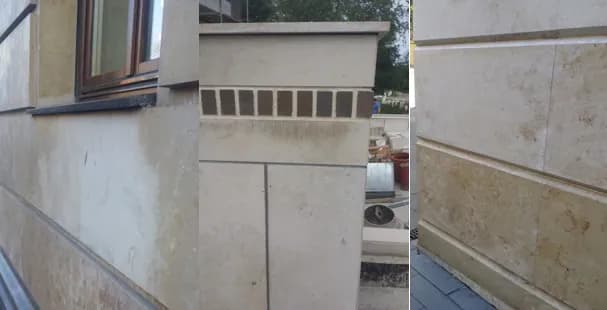 🔍
🔍Low-quality limestone may become badly deteriorated after only a year
How to determine whether beige limestone is suitable
Historic stonemasons worked the same local sources over generations and observed how their stone performed nearby. Jura Limestone has been used since Roman times for fortifications and buildings. Today's international market gives builders far less opportunity to accumulate local experience: Russia receives stone not only from temperate Central Europe but also from the deserts of Egypt, Jordan and Tunisia and the tropics of Brazil.
Initial suitability can be assessed visually by recognising structures associated with instability, but reliable evaluation of strength and durability requires laboratory testing of physical and mechanical properties.
Petrographically, many beige limestones on the market are marbled limestones. They lie between soft porous limestone, such as chalk, and fully recrystallised marble such as Carrara. Marbleisation occurs under high pressure and temperature as crustal rocks descend during tectonic movement. The resulting material may acquire properties that in some respects outperform classic marble.
Some marbled limestones take an excellent mirror polish, achieve compressive strength approaching granite and retain very low porosity. These characteristics can make them more durable than many traditional marbles.
Any natural stone, even from one quarry, can vary significantly in quality. This is particularly true of sedimentary rocks formed over long periods as climate and depositional conditions changed.
That variation must be considered when choosing an attractive branded stone in a showroom. Both famous statuary Carrara and Jura Limestone can contain weak zones depending on the exact quarry position and layer.
German beige limestone sold as Jura Marble is increasingly popular in Russia. It has a long European service record and a broad colour palette, yet the deposit contains about 25 workable layers and not all are suitable for facade use in Russian cities. Frost resistance—the ability to withstand repeated freeze–thaw cycles—is therefore a decisive durability characteristic.
Jura stone—limestone from Germany
Jura stone is a marbled limestone used worldwide for decades in private villas, airports, shopping centres and public buildings. It is quarried in Bavaria in the southern Franconian Jura around Eichstätt and the Weissenburg–Treuchtlingen area. The layered sedimentary deposit ideally comprises 27 beds, each roughly 25–100 cm thick. The uppermost layers 26–27 are generally reserved for landscape work rather than facade or floor slabs. More than twenty quarries operate in the region, including nine associated with JuraLimestone GmbH. Each location has its own colours, layers and processing characteristics; not every stone occurs or can be worked everywhere.
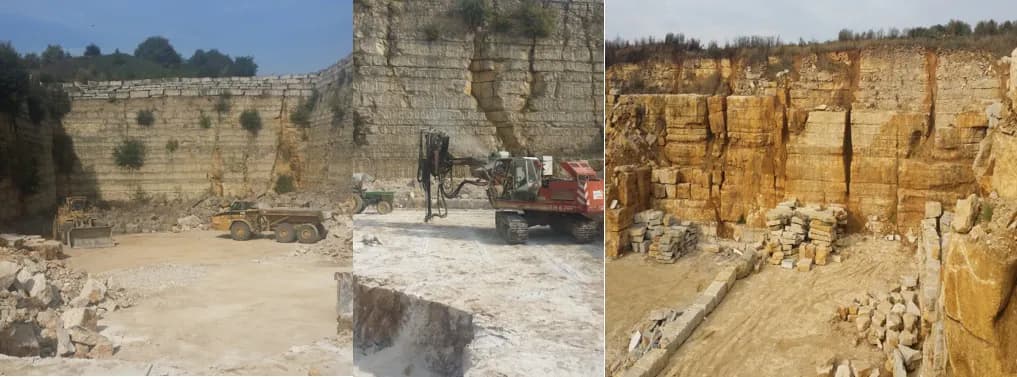 🔍
🔍Jura Limestone quarries
Most layers 1–25 can be processed. Layer 11 is distinctive at around 130 cm thick, with a banded structure and large open pores on a light-beige background reminiscent of travertine.
Other beds differ strongly: lower layers may be yellow; layer 15 at Petersbuch can be milky; upper layers include gold-yellow and darker yellow-brown tones; grey-blue stone also occurs. The deposit must be understood and divided accurately by characteristic layer and location. Departures from that classification can produce material very different from the approved appearance and performance.
This issue is particularly relevant to Jura Limestone processed in China. Blocks for that market are generally purchased at German quarries and shipped for sawing. Material procured for a specific Chinese project must be distinguished from blocks bought speculatively for slab stock. Project procurement can select the correct layers and quality at an appropriate German-standard price; speculative buying may prioritise the lowest block price, with predictable consequences for selection and consistency.