
Stone quarried as blocks is processed at a fabrication plant into cladding, architectural pieces and components for buildings or civil works. Russian standards classify natural-stone products by type and define technical requirements for each category.
Having considered the requirements for natural stone in cladding and urban architecture, the next question is how to ensure finished-product quality. Stone that does not meet the specification can compromise an entire facade or public-realm project. Complete replacement is sometimes necessary, with substantial financial consequences.
 🔍
🔍Quality control begins at the block quarry. A natural-stone deposit is a geological body and may vary not only in colour and pattern but also in technical performance. Both original formation and later geological changes contribute. At one granite quarry, for example, a single working face produces as many as four principal varieties under one commercial name (Fig. 1).
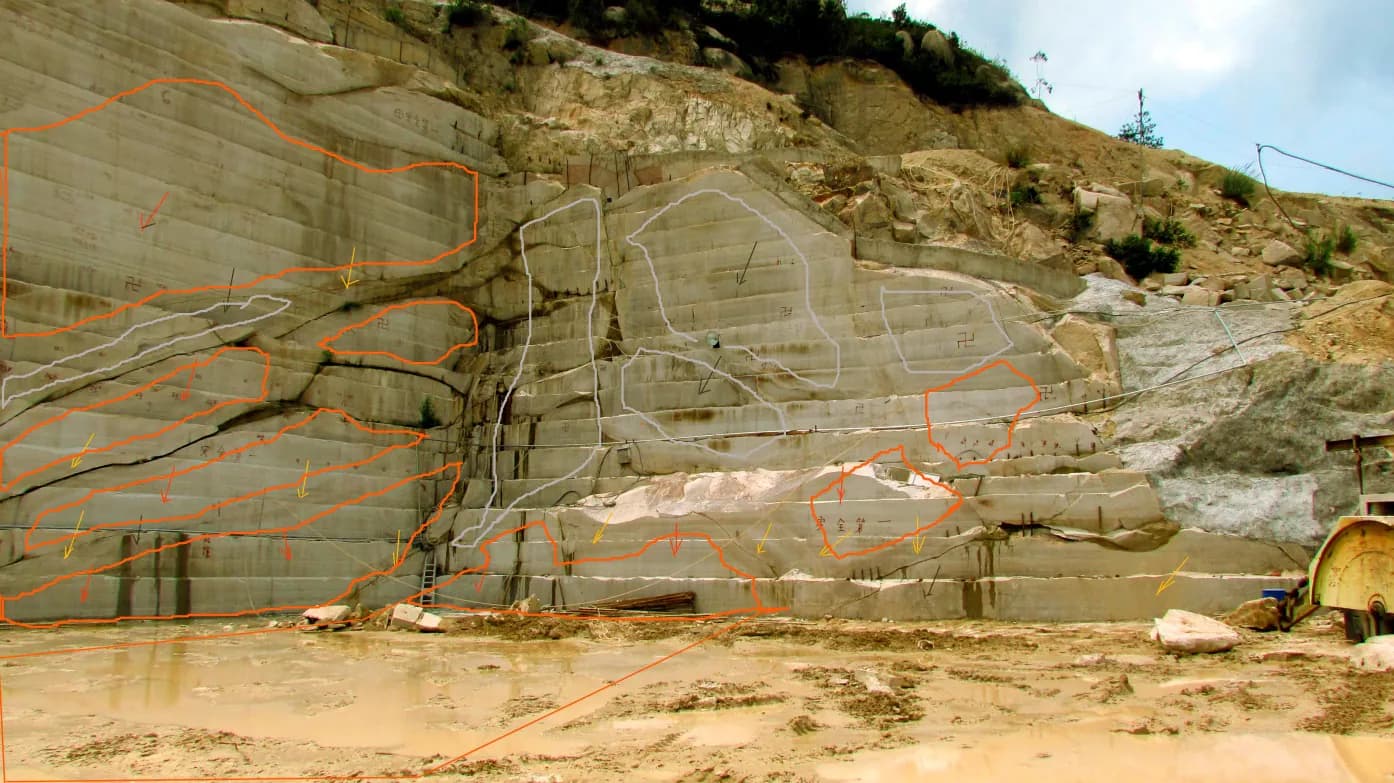 🔍
🔍Fig. 1. Granite quarry: yellow, grey and light-pink stone are worked at the same face, alongside pink-grey, grey-pink, grey-yellow and other variants.
A responsible supplier classifies blocks by quality and colour before purchase. Premium or “extra” blocks cost substantially more than second-, third- or lower-grade material. Lower-quality stone may receive an alternative commercial name rather than a clear grade, so the price range from one deposit can reveal the distinction. More seriously, inferior batches are sometimes accompanied by technical certificates based on tests of superior stone. Laboratory testing of a sample taken from the actual delivery batch is therefore essential.
Block inspection normally starts by comparing decorative properties with an approved reference. Split faces should be compared: a 15–20 cm sample is broken from the block, wetted and placed against the split reference. This exposes small differences in mineral composition and structure (Fig. 2), with 5× or 10× magnification where needed. Comparing different finishes, such as polished and sawn, is ineffective. Expected colour and pattern variations should instead be represented by several approved samples.
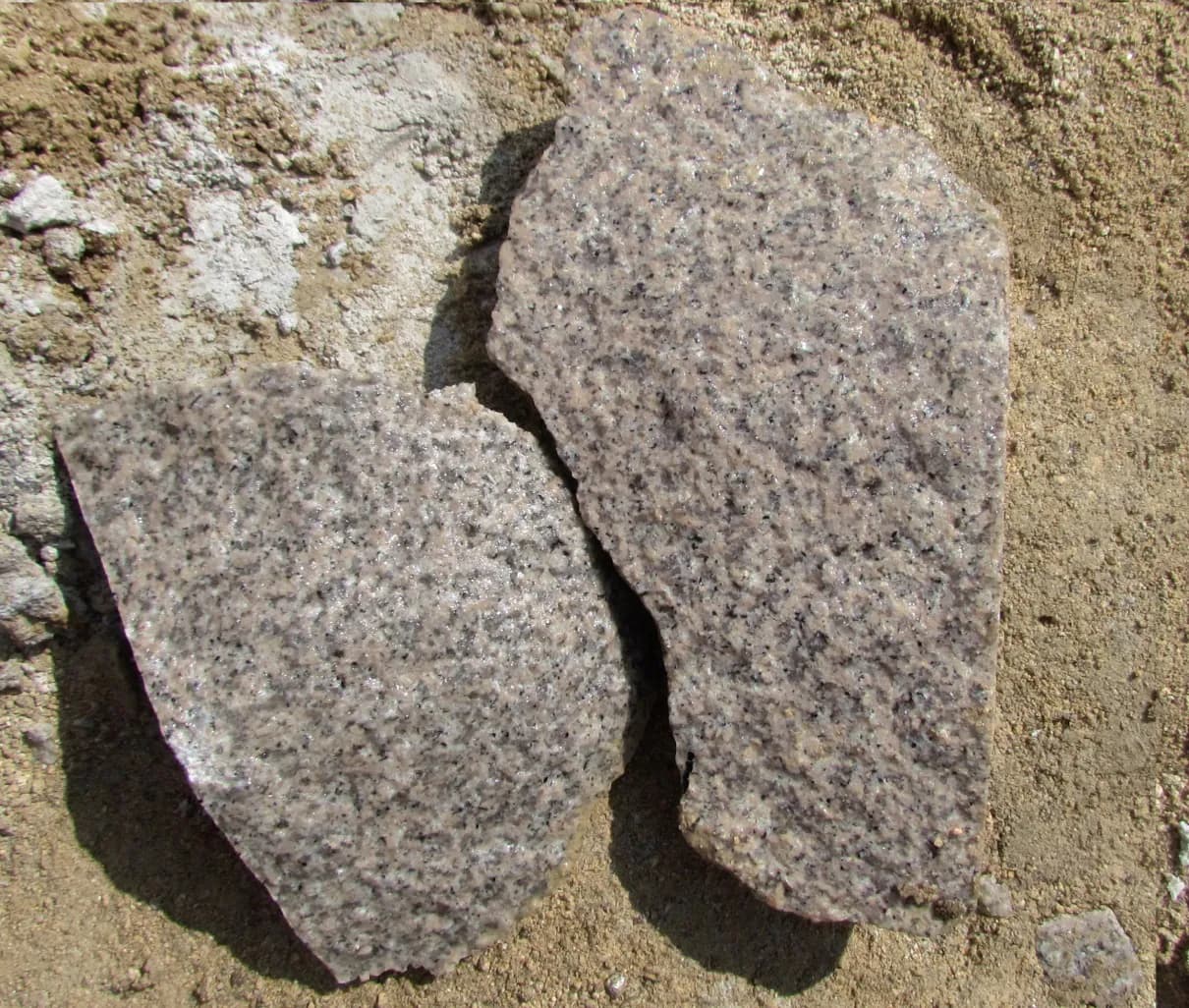 🔍
🔍Fig. 2. Checking decorative and mineralogical-petrographic properties by comparing the approved reference (right) with a sample split from the block (left)
How to buy quarry stone correctly
When buying Jura Limestone blocks, direct procurement from a quarry company with an established reputation is recommended. The purchaser pays for material suited to the stated task, not merely a brand. Because Jura Limestone is sedimentary, its blocks may contain more hidden defects than granite. Figure 3 shows one such block.
Bavarian natural-stone companies that operate their own quarries employ specialists with decades of experience at the rock face. They can distinguish suitable blocks from lower-grade stone with a high degree of confidence. Material for interiors is therefore separated from facade-grade stone, and exterior products are fabricated only from proven blocks of the required quality.
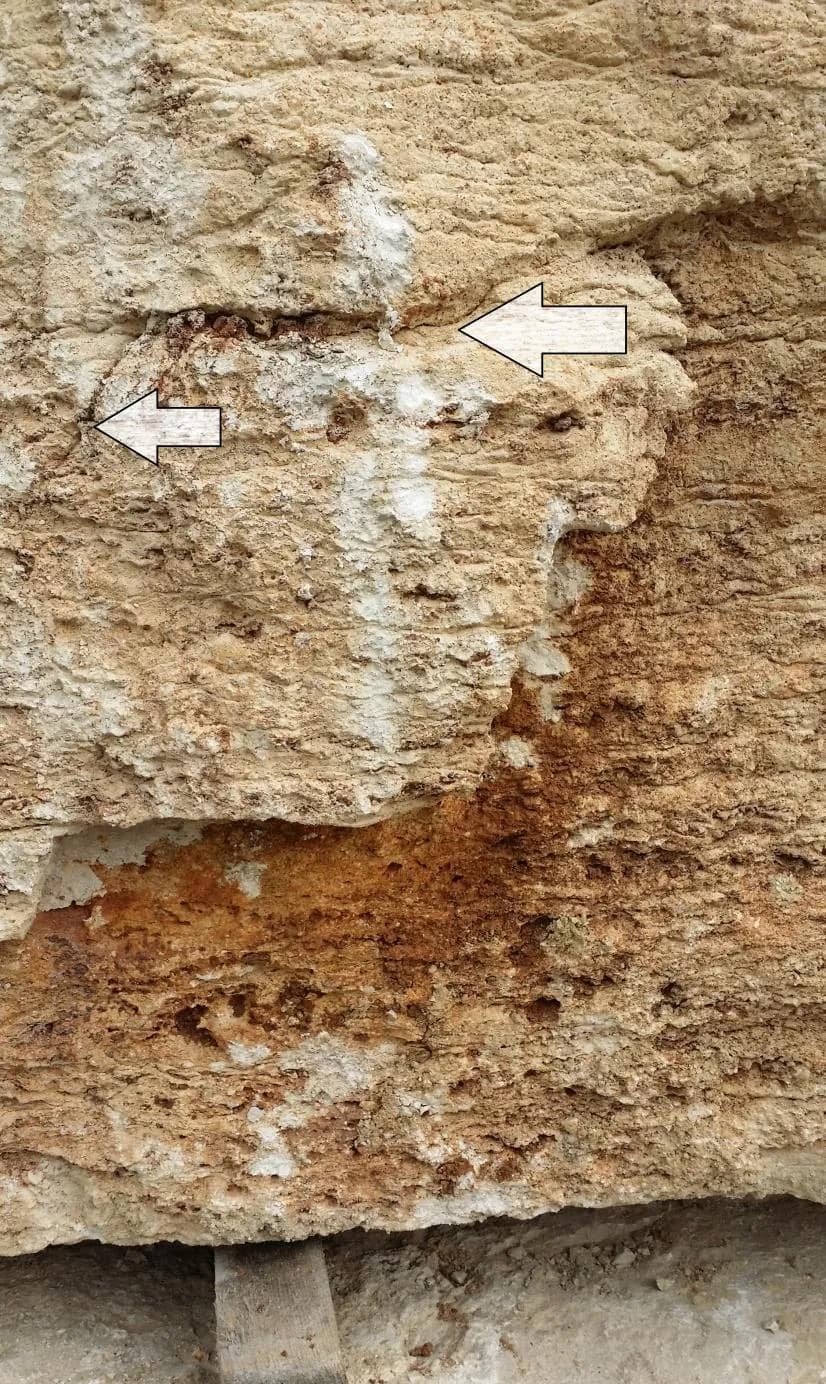 🔍
🔍Fig. 3. Jura Limestone block with an interlayer crack that limits the production of three-dimensional elements
The Jura Beige block shown is about 120 cm high but offers no more than 80 cm of usable height because the interlayer crack prevents full utilisation. A knowledgeable buyer provides drawings of the future elements, then selects suitable blocks with the quarry for the specific production task (Fig. 4).
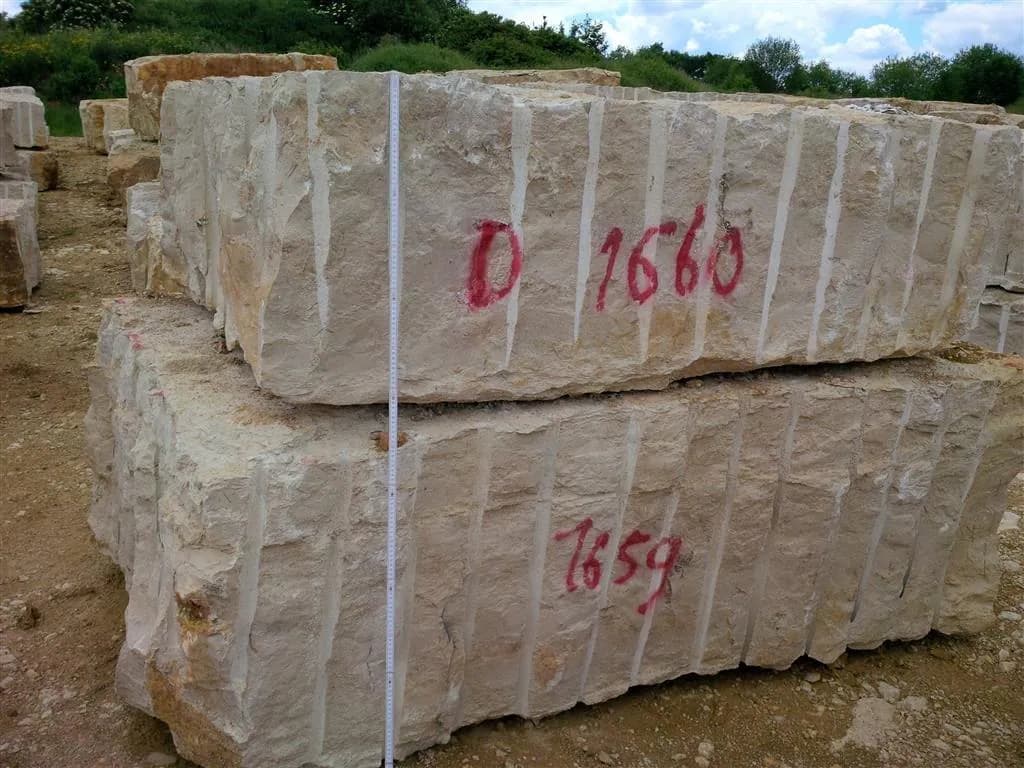 🔍
🔍Fig. 4. Good-quality Jura Beige blocks selected for a specific task from the quarry's block list, with dimensions and quarry photographs
Technical properties are harder to check because it is neither practical nor necessary to cut 35 test cubes from every block. In geological practice, parts of a deposit with the same mineral composition, structure and texture are expected to have the same or very similar physical and chemical properties. Blocks sold as one batch are usually taken from the same quarry zone, so confirming their geological similarity provides a sound basis for assessing consistency.
Instrumental methods can increase confidence. Alongside geological inspection, ultrasonic pulse velocity and radioactivity may be measured. Blocks with an average pulse velocity 20% below the reference are rejected for inadequate physical-mechanical properties. A dosimeter checks the additional radiation level, which should not exceed 34 μR/h, or 0.34 μSv/h, for raw material used in cladding products (Fig. 5).
 🔍
🔍Fig. 5. Instruments for non-destructive block inspection at the quarry and finished-stone inspection at the factory
Our data indicate that up to 12% by volume of granite blocks from the same quarry bench may fail to match the technical reference. The proportion can be considerably higher for other stones, particularly sedimentary rocks.
Block control is only the first—and smaller—part of ensuring natural-stone product quality. The remaining issues are addressed in the next article.