
Frost resistance is the ability of a water-saturated building material, including natural stone, to withstand repeated freezing and thawing without visible damage or a loss of strength beyond the limits set by applicable standards. It is one of the most important indicators of stone durability.
 🔍
🔍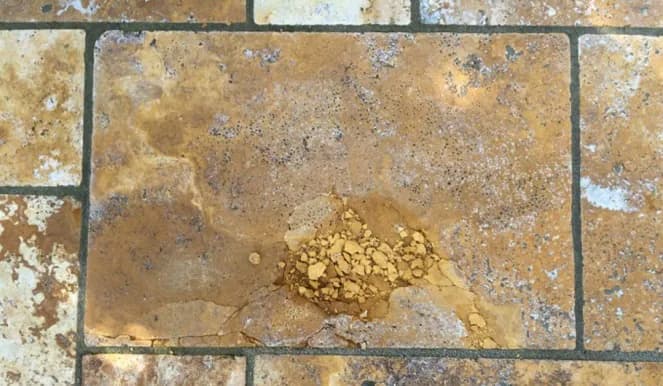 🔍
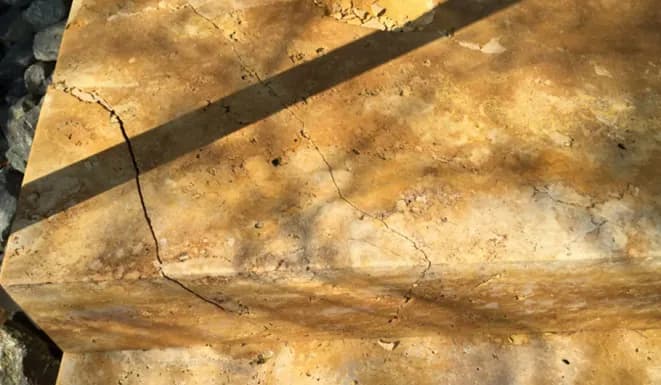
🔍Examples of deterioration in stone with low frost resistance
Extensive observation shows that water combined with repeated sub-zero temperatures damages stone structure. Closed microvoids form and grow, then connect into a permeable pore network that admits still more water. Moisture moves through this network as liquid or vapour under capillary forces and hydrostatic pressure.
Physical processes dominate the accumulation of freezing damage. Repeated freeze–thaw exposure reduces mechanical strength through structural disruption and microcracking. The degree of degradation depends strongly on the stone's water saturation and the number of cycles.
If every pore were filled and all water expanded by about 9% on freezing, widespread pore-wall failure might be expected. In practice, studies in central Russia show that only around 10–15% of pore water freezes in winter, mainly as external ice films and within larger capillaries of about 0.001–1 mm. Direct pressure from growing ice crystals is small, around 0.04–0.06 MPa, whereas hydrostatic pressure caused by water–ice volume change in a closed or semi-closed space can reach 200 MPa at an air temperature of −22°C.
A thin water film remains on pore surfaces and can create a vapour phase even after part of the water freezes. Cooling develops hydraulic pressure in the smallest pores and drives unfrozen water from smaller pores towards larger ones, causing more damage than simple air freezing. The resulting stress depends on the rate of ice formation and on empty compensating pores that can dissipate local pressure. Research suggests that the most frost-resistant limestones have approximately equal, interconnected pores forming a capillary network. In such stones, water absorption alone does not predict frost resistance: materials including Myachkovo and Melekhovo-Fedotovo limestone, Berezovsky dolomite and Jura Limestone may absorb water readily but also release it quickly. Stones that release moisture much more slowly than they absorb it are less resistant. Mineral-grain cohesion, the balance of narrow and wide open pores and many other factors also matter.
Frost-resistance testing of natural stone
Requirements are set by standards including GOST 9479-2011, GOST 30629-2011 and EN 12371. Stone for blocks and architectural products is assigned a frost-resistance class such as F15, F25, F35, F50, F100, F150 or F200. The supply contract should state the class, selected for the climatic zone, intended service life, exposure and moisture conditions, and applicable building regulations.
Tests use 40–50 mm cubes or cylinders of similar diameter and height, normally five samples for each assessment stage—15, 25, 50, 75, 100 cycles and so on. Samples remain in a chamber at −20 ± 2°C for four hours, then thaw completely in water for at least two hours before the cycle repeats. Five water-saturated samples are tested after 15, 25 and each subsequent 25 cycles under GOST 30629-2011; European procedures also use flexural tensile tests. Strength loss is calculated from the difference between dry and post-cycle saturated compressive strength, using the mean of five specimens. Layered stones are tested both parallel and perpendicular to bedding. A stone meets the stated class when compressive or flexural strength loss does not exceed 20%. Samples are inspected for edge chips, corner loss, spalling and crack failure. Completely destroyed samples count as zero strength; partially damaged ones remain in the test set.
Some accelerated tests replace freezing with impregnation by crystallising salts such as sodium or magnesium sulphate. The assumption that sulphate crystallisation reproduces freezing is disputed. Salt behaviour may depend more on polymorphic changes during wetting, drying and temperature variation than on crystal-growth pressure alone. Unlike freezing water, salt solution acts mainly near the surface it can penetrate; weak stone therefore tends to lose outer layers rather than fail throughout.
Loss of stone strength is only the first stage of climatic deterioration. It is followed by scaling, surface and internal macrocracking, delamination and eventual failure.
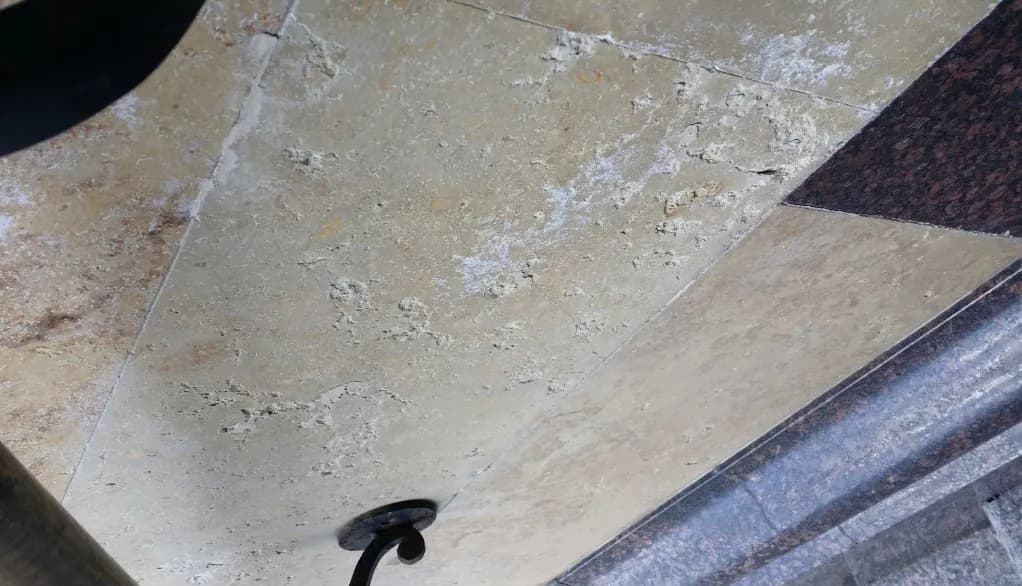
Jura Limestone occurs in layers with a long record of use. Some layers are known not to meet exterior frost-resistance requirements and responsible suppliers do not recommend them for facade cladding. The evidence can be visible in an open quarry after winter, where particular exposed layers show clear weathering while others remain intact.
 🔍
🔍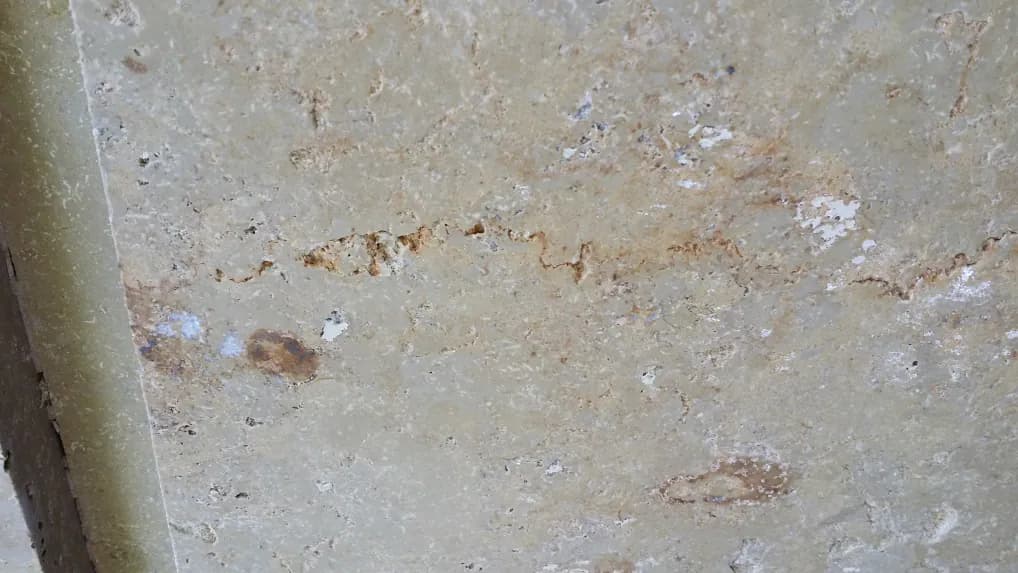 🔍
🔍Examples of frost damage in Jura Limestone with weak resistance and visible structural defects such as stylolite seams
If strength loss has not yet reached a critical 25–30%, deterioration may be slowed through a coordinated conservation programme: systematic monitoring with electronic non-destructive methods, periodic water-repellent treatment, joint sealing, consolidants, fluosilicate treatment and related measures.