
The rapid expansion of stone varieties on the market gives builders little time to develop experience across different climates and uses. An independent specialist can make an initial assessment through visual inspection supported by non-destructive instruments.
Reliable confirmation of suitability for a particular cladding application nevertheless requires laboratory testing of physical and mechanical properties. The supplier's integrity remains equally important. Tests may show that selected Jura Limestone withstands up to 250 freshwater freeze–thaw cycles, but the supplier is still responsible for selecting the actual material delivered to the project.
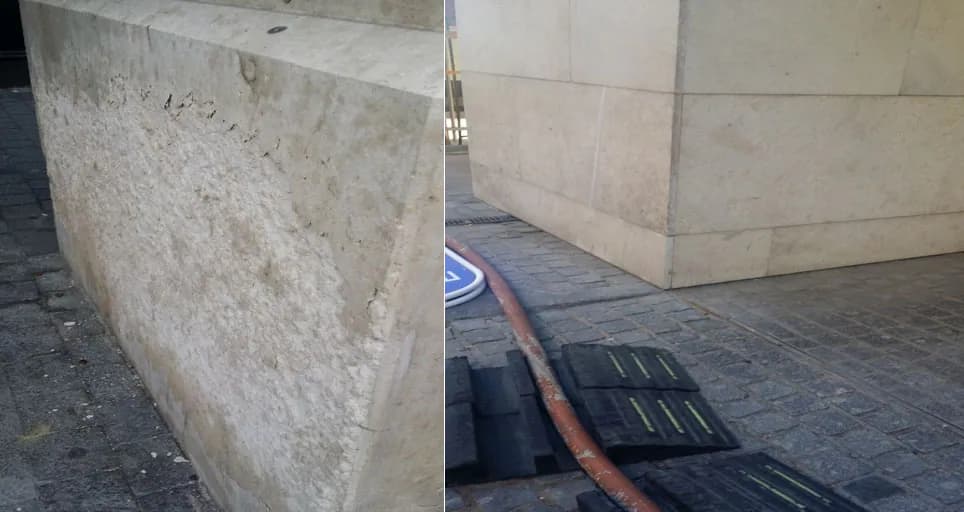 🔍
🔍These two public-building plinths illustrate the difference: the one on the left is deteriorating, while the one on the right remains serviceable and should last for decades.
GOST 9479-2011, Blocks of Rock for Facing, Architectural, Memorial and Other Products, requires ten parameters: mean density, water absorption, dry compressive strength, loss of compressive strength after saturation, abrasion, impact resistance, weather resistance including acid and salt resistance, effective activity of natural radionuclides, decorative properties and harmful impurities.
Table 3 sets different limits for different rock groups. Marble and marbled limestone are grouped as medium-strength rocks, with mean density of at least 2,600 kg/m³, water absorption no more than 0.75%, dry compressive strength at least 50 MPa and strength loss after saturation no more than 30%.
Marble, however, began as limestone. During crustal movement, limestone strata either rose and weathered or descended several kilometres. Temperature and pressure increase with depth.
High temperature, immense pressure and hydrothermal fluids alter limestone structure. Cryptocrystalline calcite [CaCO₃], with grains below 0.001 mm, recrystallises: grains grow and fill spaces between organic fragments and within larger fossil debris. The resulting pore structure has a major influence on physical and mechanical performance.
The finest pores differ according to origin and formation. Some fill completely with water; others are isolated and remain dry. Some retain an air pocket during saturation. Narrow channels may contain water that does not freeze even at substantially sub-zero temperatures.
The proportions of these pore types determine frost resistance. Water expands when freezing, but unfrozen water and air-filled voids act as buffers that reduce damaging pressure. A stone with more such compensating pores can therefore be more frost resistant even when its total porosity is not especially low.
For limestone, GOST 9479 also defines a low-strength group divided into dense and porous materials. Mean density and water absorption are not generalised for this group—not because low density or high absorption is desirable, but because these values vary widely and their relationship to limestone quality is material-specific. Compressive strength is set at 10 MPa for porous limestone and 25 MPa for dense limestone; allowable strength loss after saturation is 35% for both.
Jura Limestone has a low to medium degree of marbleisation, and its average properties vary by layer. For exterior work, only layers 10–11, 14–17 and 21–25 are used. With professional selection and frost resistance up to 250 cycles, suitable stone can perform for the building's full design life.
 🔍
🔍The British Embassy wall on Smolenskaya Embankment in Moscow, built with Jura Limestone supplied by JuraLimestone GmbH; the stone has served for more than twenty years.
Recrystallisation reduces the original pore structure of limestone and, when marbleisation becomes complete, removes it. Marble then develops a different system of intergranular pores. Its relationship with quality is more uniform, which is why standards specify density and water absorption for marble.
Recrystallisation changes other physical-mechanical properties as well. Growing carbonate crystals meet, interlock and curve around one another. Where pores are absent, this can greatly increase dry compressive and flexural strength.
Limestone and marble are the two ends of a continuum; marbled limestone lies between them. GOST 9479 does not directly account for the degree of recrystallisation. Natural deposits include rocks ranging from only a few percent to 80–90% marbleisation. Our studies show that their physical and mechanical values can differ dramatically from both primary limestone and fully recrystallised marble.
Some Jura Gold selections, despite mean density below the standard marble threshold, reach 181.7 MPa compressive strength—higher than granite at about 2,700 kg/m³—because of the particular interlocking of recrystallised grains with other structures. Jura Travertine from Petersbuch has reached 98.72 MPa at 2,380 kg/m³ density and 2.54% water absorption, while remaining resistant to more than 150 freeze–thaw cycles. Petrographically it is a marbled limestone with a relatively low degree of recrystallisation.
 🔍
🔍For this reason, quality assessment of marbled limestone should determine the degree of marbleisation under a microscope. Where recrystallisation is below 50%, generic marble limits for mean density and water absorption should not be applied without considering the limestone's specific structure and test record.
When stone—especially marbled limestone—is selected for facades or interiors, laboratory investigation should identify all potential adverse factors. Petrographic analysis must receive particular attention and explicitly determine the degree of recrystallisation or marbleisation.
 🔍
🔍