
Steven Spielberg's Jurassic Park made the Tyrannosaurus one of popular culture's best-known prehistoric animals. Strictly speaking, however, that predator lived in the Cretaceous period that followed the Jurassic. What lived during the Jurassic, approximately 195 to 135 million years ago?
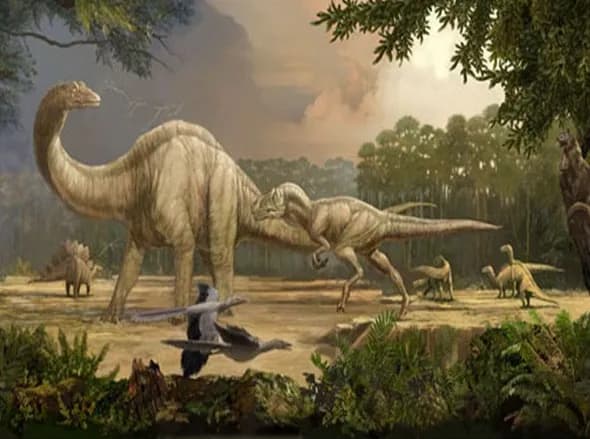 🔍
🔍Geologists divide the Jurassic into three principal intervals.
The name comes from the Jura mountain range in northern Switzerland; in an old regional usage, the word referred to forested mountains. Around two centuries ago, geologists applied it to corresponding strata in the Swabian and Franconian Jura of Germany.
The geology of these intervals and their present-day human use can be summarised as follows.
The Black Jura, or Lias, can reach about 200 metres in thickness. It contains oil-bearing sands from which fuel could be produced, though this is not currently economical. The Brown Jura, or Dogger, can likewise be around 200 metres thick. Metal oxides and hydroxides give its limestone and sandstone a brown colour; until about 1950, parts of it were enriched for iron-ore extraction.
The White Jura, or Malm, can reach 500 metres and consists mainly of dolomite and limestone. A shallow prehistoric sea or lagoon once covered the Franconian Jura. Its diverse inhabitants are now preserved in the rock: ammonites, belemnites, sponges, corals, algae, crustaceans, fish and starfish.
This variety of natural patterns—and occasionally complete fossils—is what makes Jura stone distinctive. Despite the common commercial name Jura Marble, it is geologically a marbled limestone.
The stone lies in layers and is worked by open quarrying. After topsoil removal and initial rock opening, specialised equipment saws or hydraulically separates roughly rectangular blocks from different benches for processing at stone factories. Companies with their own quarries, extraction licences and factories can control selection, sorting and fabrication most effectively. Some have accumulated knowledge over generations. Laboratory tests alone cannot predict every property of a natural material; decades and even centuries of service evidence show which layers perform on facades and which hide risks. After winter, low-frost-resistance layers can even be recognised directly by visible damage in the quarry face.
Frost resistance is especially important in central Russia, where temperatures repeatedly cross 0°C in late autumn and early spring. For a facade in this climate, it is one of the principal determinants of durability.