
At a stone-processing plant, quarry blocks are transformed into cladding, architectural elements and components for buildings or civil works.
At the quarry, only the block's outer faces can be assessed for colour and pattern; its centre remains hidden until sawing. Defective zones may therefore enter the slab stock. Even granite blocks can contain small areas of different colour or structure, known as schlieren. In one example, up to 5% of blanks contained dark gabbro-diabase schlieren or pegmatite cavities (Fig. 1).
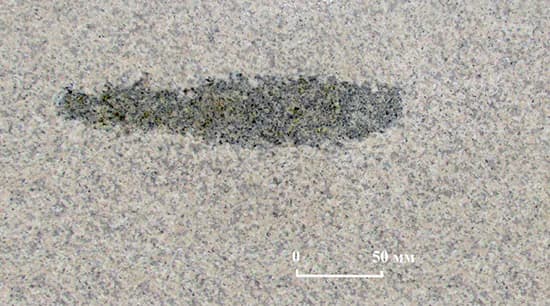 🔍
🔍Fig. 1. Dark gabbroid inclusions in blanks of light-pink granite
Cladding components made from such blanks will inevitably be rejected. Identifying them at the beginning of processing saves unnecessary cost. Sedimentary and metamorphic stones may naturally produce a still higher proportion of blanks with defects.
Jura Limestone, particularly grey selections, may contain pyrite that later causes serious visual problems on a facade. Such inclusions are typical of layers 1 to 6, which include grey-blue Jura Polarblau. Responsible suppliers therefore always ask whether the stone is intended for a facade or an interior.
Figure 2 shows pyrite staining on blocks rejected at the Petersbuch quarry in Germany.
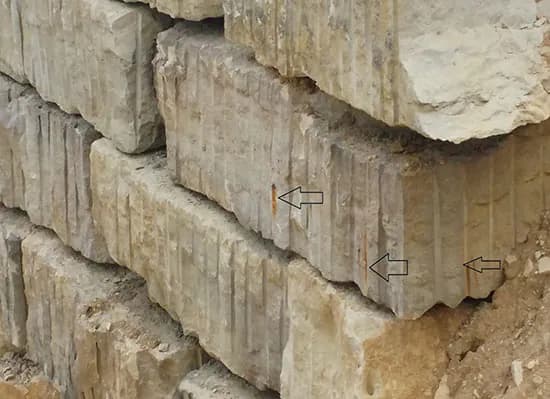 🔍
🔍Fig. 2. Pyrite inclusions and staining on Jura Limestone blocks
Quality control must also consider the stone's decorative characteristics, mineralogy and radioactivity. At the fabrication stage, however, the main issues are usually component geometry and the quality of the specified surface finish.
Our experience with final inspection of granite elements shows rejection rates of up to 6% because of fabrication cracks or dimensions outside the drawings. Similar man-made defects occur in Jura Limestone and can unfortunately reach the facade of an expensive premium building if controls fail (Figs. 3–5).
Incoming inspection immediately before installation is equally valuable. Defective pieces may have escaped the factory's final inspection because of technical or, more often, administrative failures.
Other damage can occur during packing, transport, unloading, pre-installation preparation or installation itself.
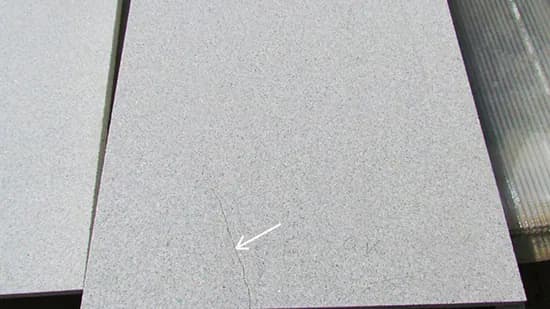 🔍
🔍Fig. 2.1. A man-made crack in a granite slab caused during production or transport and identified by incoming inspection
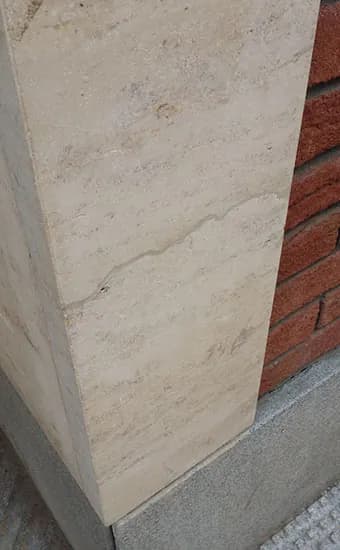 🔍
🔍Fig. 3. A man-made crack in a Jura Limestone slab caused during production or transport and missed by incoming inspection
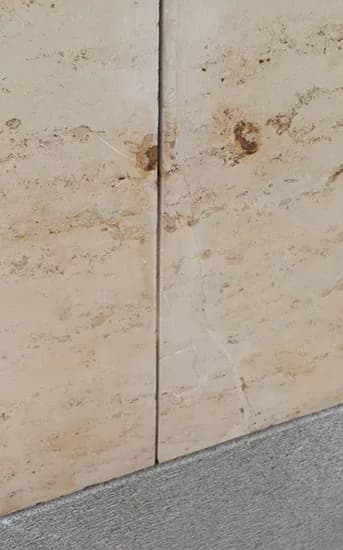 🔍
🔍Fig. 4. A man-made crack in a Jura Limestone slab caused during production or transport and missed by incoming inspection
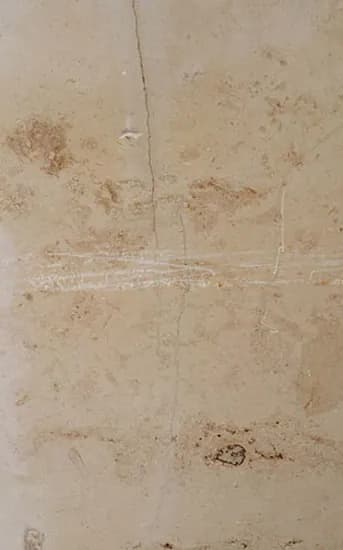 🔍
🔍Fig. 5. A man-made crack in a Jura Limestone slab caused during production or transport and missed by incoming inspection
Achieving proper stone-cladding quality
In our view, acceptable stone cladding cannot be achieved without quality control of the raw stone and finished components at every production stage. Our approximate data suggest that up to 70% of stone-clad buildings require some repair within their first years of service.
This article is intended for teams willing to learn from others' experience. Inspecting every slab is costly, so the most effective first step is to choose a responsible producer that values its reputation. An unrealistically low initial price often leads to repeated expenditure later.
A reliable partnership saves time, money and considerable stress. Some prestigious buildings of the 1990s have already lost part of their status because even an excellent location cannot compensate for poor materials or unprofessional installation.
The market for premium homes and apartments is increasingly competitive. Affluent buyers consider expensive property both a place to live and a liquid asset. A costly building whose facade quickly becomes an unattractive mosaic of defective stone cannot meet that expectation.