
Natural stone first entered architecture because it represented permanence and strength. As artistic practice developed, colour and pattern became equally important. Few building materials can match its durability: timber and plastics decay, steel corrodes, while suitable stone can survive for millennia. Yet stones differ greatly. A few clear rules are needed if the investment in natural-stone cladding is to deliver the intended result.
 🔍
🔍Stone colour and pattern
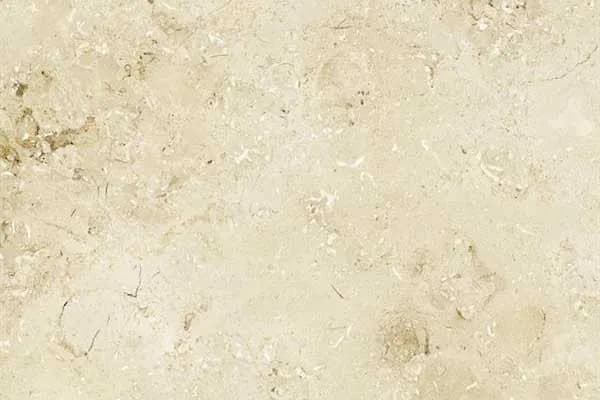
Once natural stone has been chosen, the client and architect usually select a variety by colour and pattern. Nature offers an enormous palette, but saturated blue, purple or yellow stones are rare and may cost several times more than common colours. The brightest and most uniform selections likewise command a premium.
Synthetic products can be manufactured to predetermined properties; natural stone reflects changing geological conditions over millions of years. Jura Limestone is a sedimentary rock formed about 135 million years ago and deposited in extensive layers. More than 150 years of industrial quarrying have documented each layer closely, allowing its visual characteristics to be predicted with a high degree of confidence.
Gabbro and labradorite are among the most stable stones in colour and pattern, and some granites also remain consistent over large areas. Marble and gneiss can vary far more, making adjacent slabs difficult to match. An experienced supplier digitally lays out slabs and agrees the composition with the client for design-critical work. The same principle applies to Jura Limestone: selection from a responsible producer begins at the quarry.
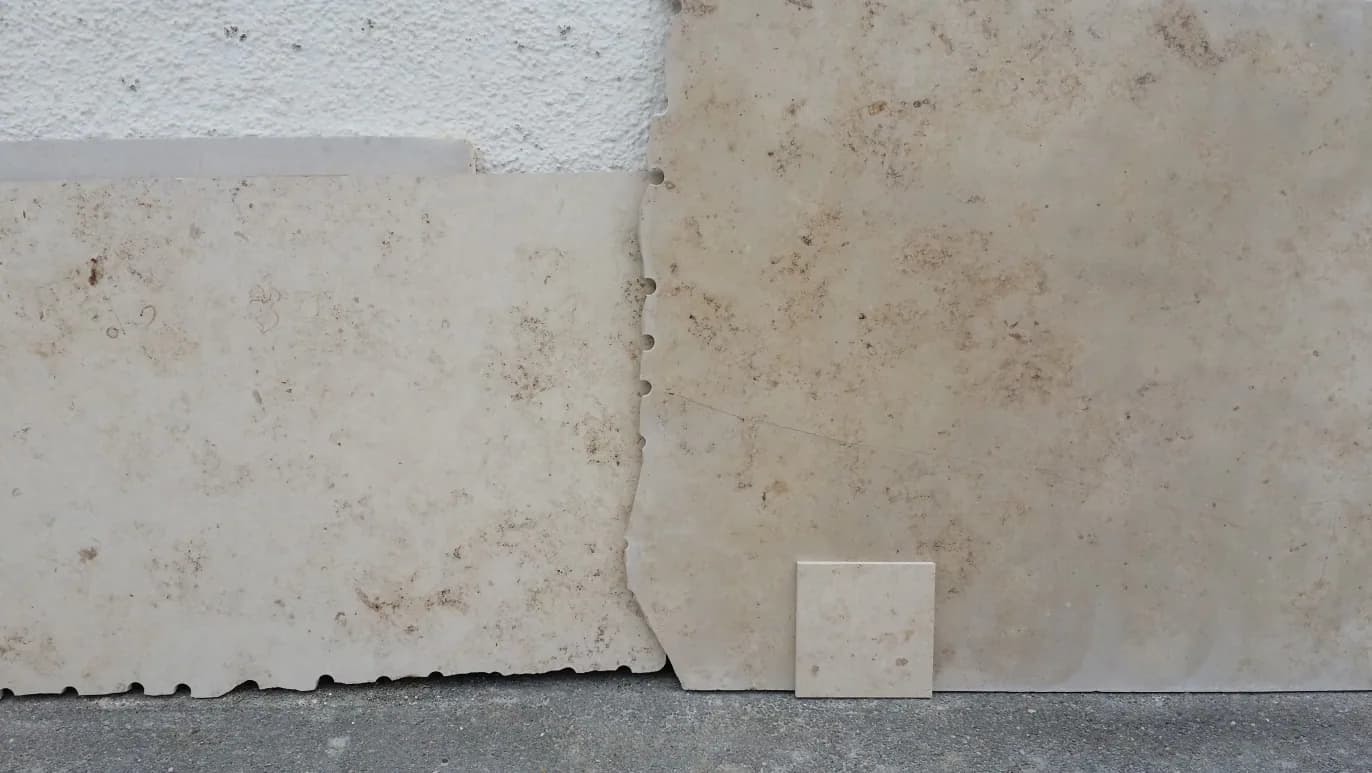
After small Jura samples are approved, representative slabs are selected at the quarry in the presence of the architect and client, photographed and recorded together with the exact quarry and layer. Unacceptable visual defects and maximum permitted variation are marked on these slabs. A fresh slab contains more moisture than a sample, so its surface may need to be dried—using a gas flame, for example—for a valid comparison. The illustration shows the difference between the small reference and dry and wet areas of a slab from the same layer.
 🔍
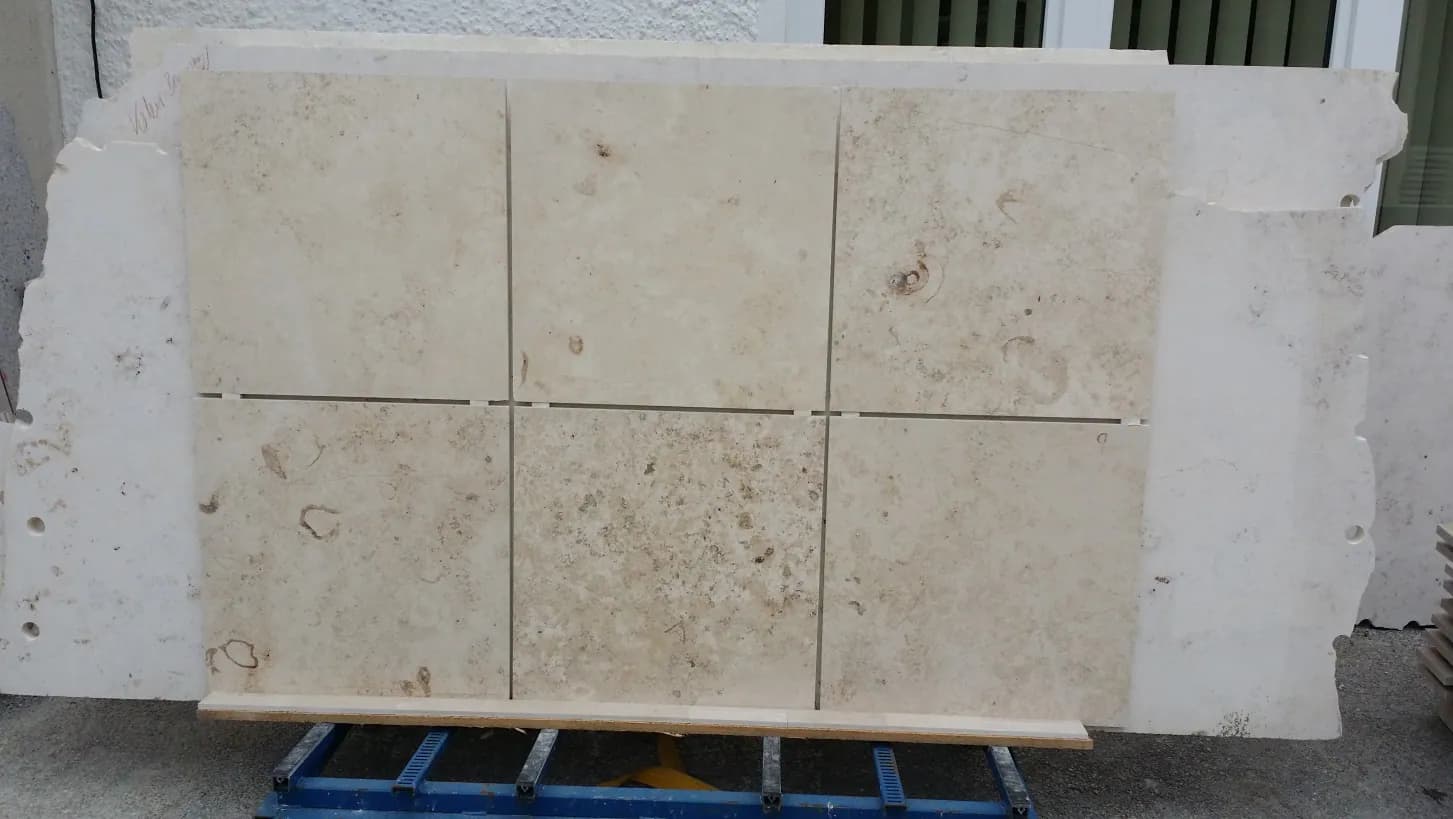
🔍For flooring, finished format tiles from the chosen layer are sometimes placed side by side to approve the acceptable range of colour and fossil concentration.
 🔍
🔍Stone strength and performance
Clients often pay little attention to physical-mechanical properties, and limited material knowledge within the design team can lead to avoidable failures.
Properties must match the application. Highly porous or weakly abrasion-resistant limestone, slate, Roman travertine or shell stone may be unsuitable for floors. Stone with elevated radioactivity must not be used indoors. Plinth stone with water absorption above 0.2% requires detailing that prevents wetting. Exterior stone should achieve at least F50 frost resistance, and in heavily trafficked cities where de-icing salts may be used, at least 150 cycles are advisable. Ventilated facades may use strong or medium-strength stone, but material with compressive strength below 50 MPa, or 500 kg/cm², is not permitted.
Suitability must therefore be established through physical, mechanical and chemical testing. Exterior stone is exposed to temperature variation, rain, salts, acids and winter freezing, all of which can cause deterioration.
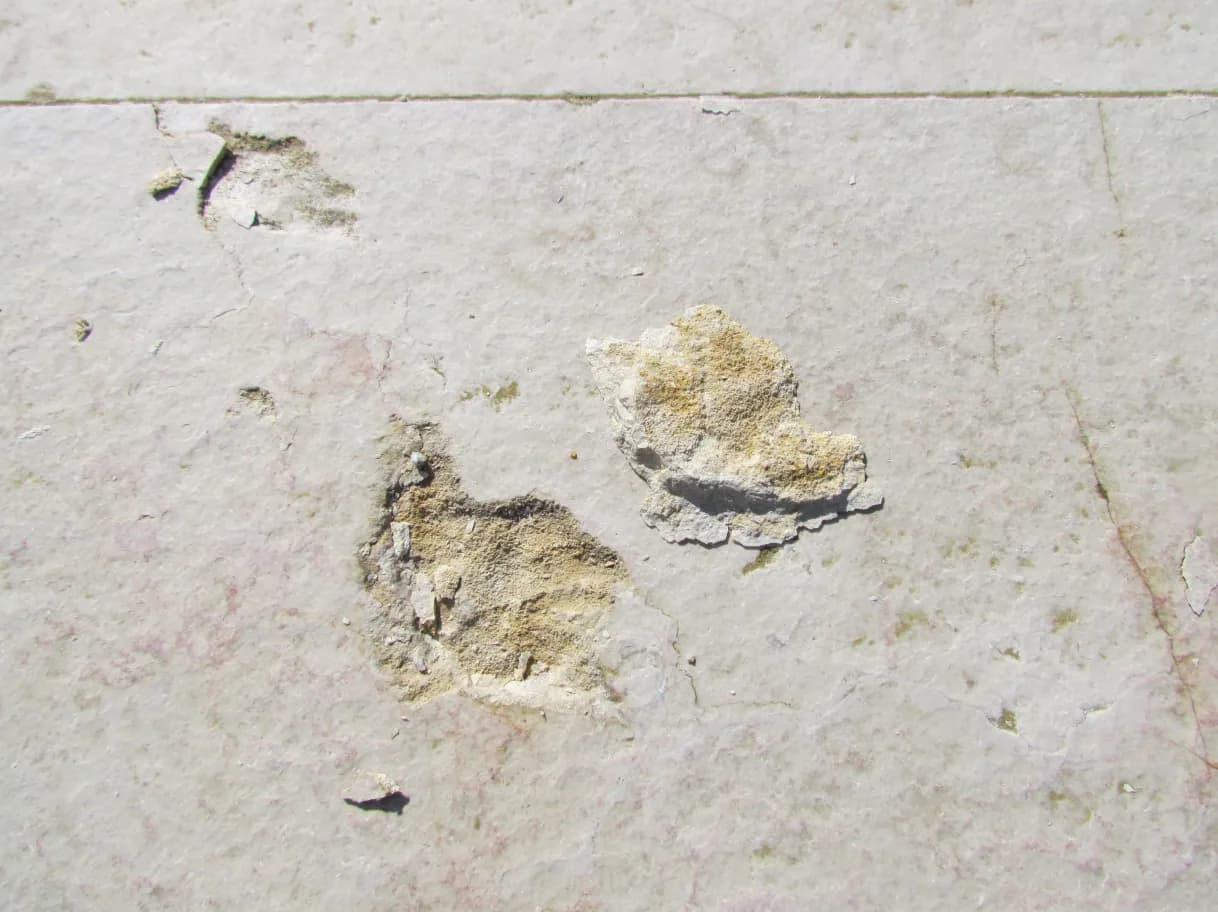 🔍
🔍Stone deterioration caused by frost weathering
Exterior cladding consequently faces stricter requirements than interior stone. These are set out in GOST 9479-2011, Blocks of Rock for Facing, Architectural, Memorial and Other Products—Technical Specifications.
Requirements for natural stone used in exterior cladding
A complete physical-mechanical test programme requires at least forty accurate 50 × 50 × 50 mm cubes, four 200 × 200 × 30 mm plates for impact resistance and three polished 300 × 300 mm plates for mineralogical-petrographic analysis. Test cubes must have true geometry; non-parallel faces can significantly distort the results.
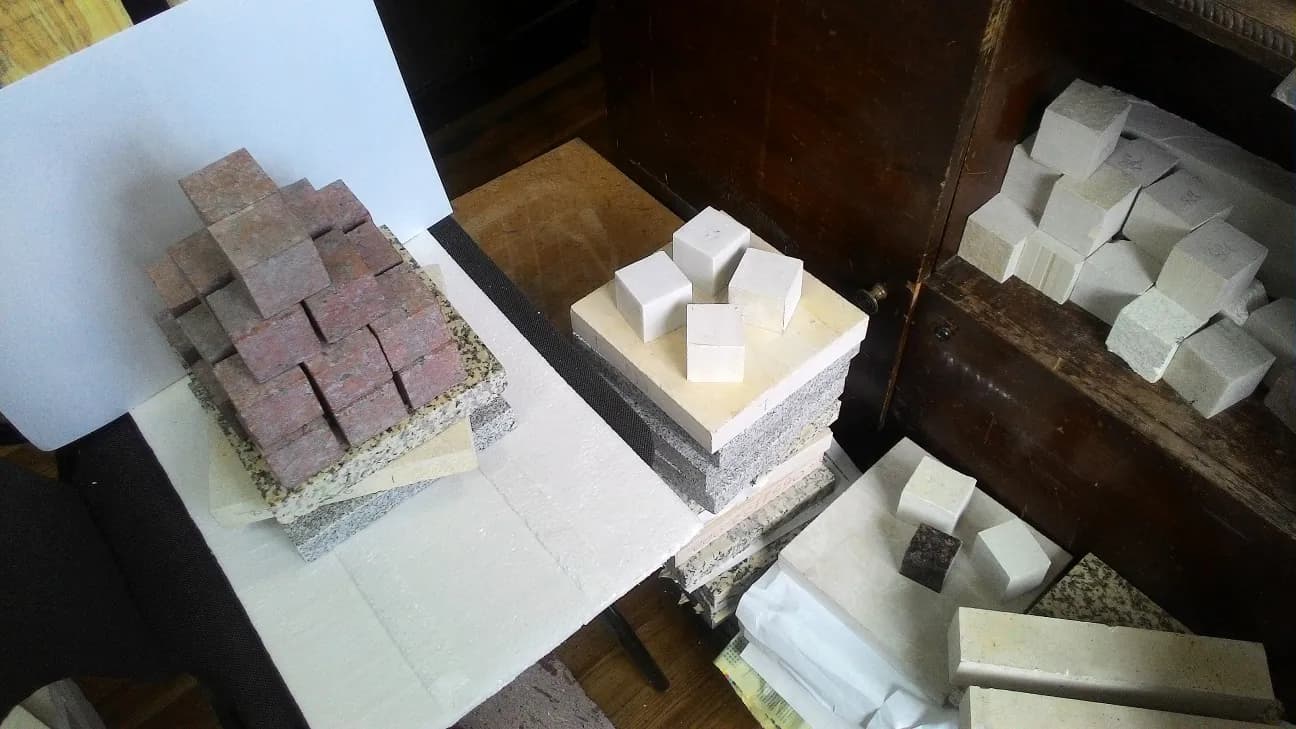 🔍
🔍Natural-stone cubes and plates received for laboratory testing
Laboratories test stone under GOST 30629-2011, Facing Materials and Products of Rock—Test Methods. Each new batch of cladding should normally be supported by tests, and its properties recorded in the accompanying technical certificate. Frost resistance is one of the principal durability indicators. It describes resistance to repeated freezing and thawing, particularly in late autumn and early spring. In large cities, water containing dissolved de-icing salts can create still greater pressure within the capillary structure as it freezes, accelerating facade damage.